Kitchen Island Countertops
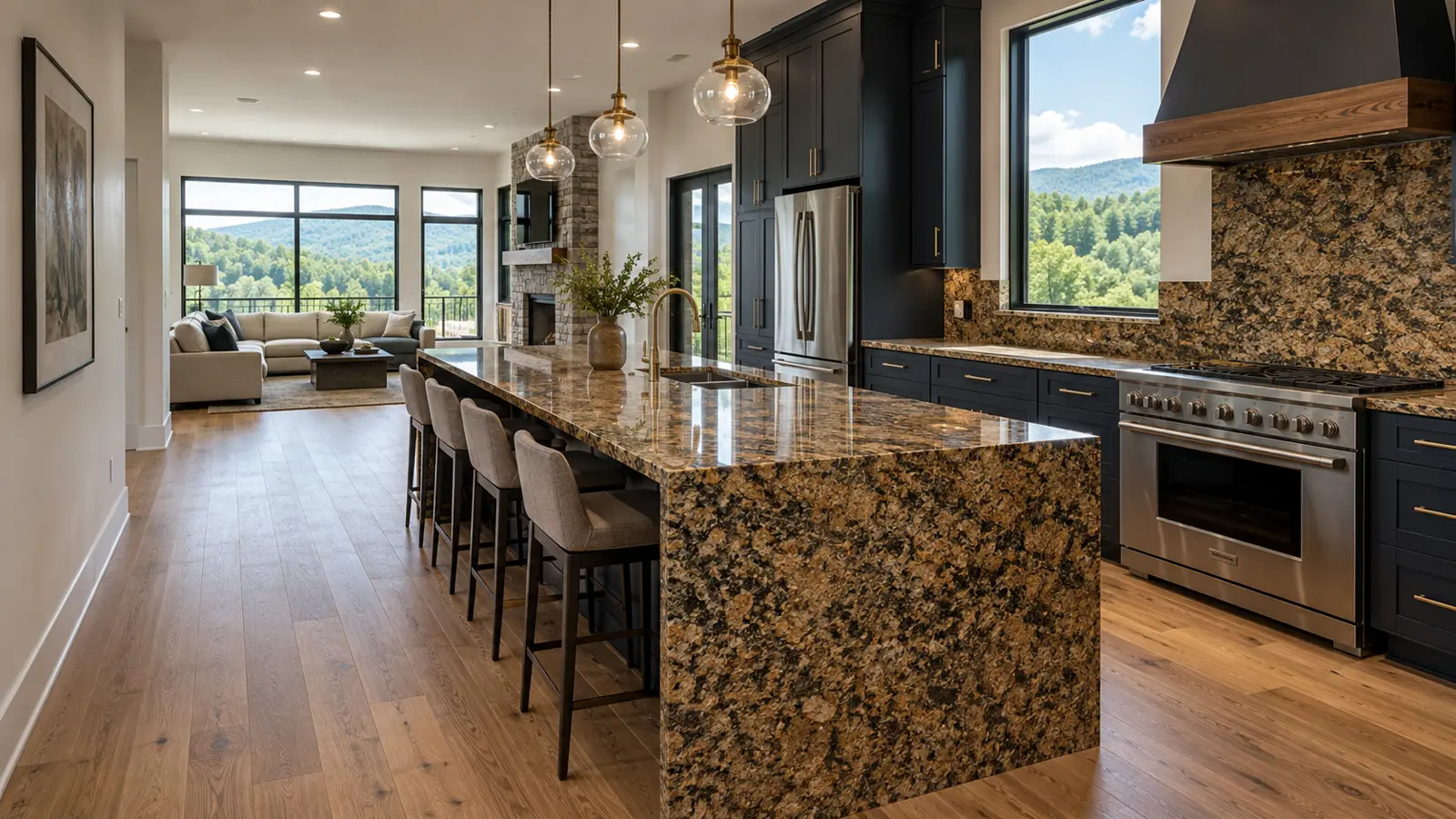
Seating overhang, the support under it and whether the top needs a seam, all settled at the measure before any stone is cut.

Buncombe Custom Countertops is a specialist in countertop services in Buncombe County, NC, specializing in kitchen installation, countertop replacement and bathroom vanity tops. We offer quartz, granite, quartzite and marble in full slabs, plus butcher block and cast concrete.
Our team provides fabrication for builders, cabinet shops and restaurant owners, delivering tops sized to the job for both residential and commercial projects. Before a single cut, we lay out the seams on the slab you chose and hold fabrication until you approve that seam layout, and every countertop is then cut in our shop.
From edge profiles and faucet holes to a builder's full package of kitchens and baths, our team handles every detail. Serving Asheville, Woodfin, Black Mountain and Fairview, one crew carries the same standards from a single vanity to a taproom bar.
Why Buncombe Custom Countertops
The crew that measures your kitchen is the crew that sets the tops.
For homeowners, by job
Seating overhang, the support under it and whether the top needs a seam, all settled at the measure before any stone is cut.
The top and the side panel come from the same slab, mitered at 45 degrees and glued into one piece before it leaves the shop.
Every outlet box, window edge and cabinet line is recorded when the counters are templated, and the openings are cut before the stone reaches your house.
Chosen for summer sun, heavy rain and winter nights below freezing, with the grill opening cut to your grill maker's size.
Install day is planned at the template: the cabinets are checked, the seams are agreed and the sink and cooktop openings are fixed before any stone comes off the truck.
Sound cabinets can take a new top. We take the old one off carefully, show you what it was hiding, and template the new stone on the same boxes.
A bathroom vanity needs a small piece of stone, so it can come from a remnant. Pick the basin and faucet first and we cut the top around them.
Most chips can be filled and polished. A crack is judged on what is holding the stone up, and if a new top is the better spend, the quote says so.
For homeowners, by material
Some stone sold as quartzite is softer marble or dolomite. Before you commit, we help you test the slab you love.
Choose a color from a sample and the slab arrives looking like it. We also tell you plainly where quartz needs a trivet.
No two granite slabs match, so you choose the actual stone, approve where the seams fall, and learn the sealing routine before install day.
Marble etches, softens and records every lemon and every loaf. If that is the look you want, we will help you pick the finish that wears it best.
A warm wood island, a baking counter or a full run of wood, built with the right grain, the right finish and room for the wood to breathe.
An industrial, handmade surface in any color you can mix. We explain how it is cast, what the sealer does, and what a hairline crack means before you commit.
For builders, shops and owners
Bids broken out by area and phase, shop drawings returned before fabrication, and templates booked around the trades already on your site.
Surfaces specified for spilled beer, citrus, heat and a thousand wipe-downs a week, fabricated on a calendar that ends at your opening night.
One standard spec across the building, turns booked around move-out and move-in, and a bid you can read unit type by unit type.
One package per floor plan, templated house by house on the installed cabinets, with upgrade options your sales team can put in front of buyers.
You sell the top, we cut it to your drawings or your templates, and it reaches your customer under your name.
If you know what you need done but not yet what it should be made of, start with the job. These pages explain the work itself: what gets removed, what gets built and what the day looks like.
New tops on new or existing cabinets, templated after the boxes are set and installed by the crew that measured them.
Old laminate, tile or worn stone out, new stone in, on the cabinets you keep, including kitchens that took on water and need a fresh top.
Large single pieces with seating overhangs, where seam position and overhang support are the decisions that matter.
The slab runs over the island edge and down to the floor through a mitered corner, usually with the veining matched around the turn.
Stone carried from the counter to the upper cabinets or the ceiling in one piece, in place of tile and grout lines.
Single and double vanities, often cut from a remnant of a kitchen slab when the stone and the sizes allow.
Tops for decks, patios and grilling stations, where the material has to handle sun and freeze-thaw rather than just look good.
Chips, cracks, loose seams and dull spots fixed in place when a repair makes more sense than a new top.
The material pages answer a different question from the job pages: not what we will do, but which surface suits your kitchen, your cooking and your patience for upkeep. Read one of these once the job is clear and the choice is between stones.
Engineered stone is about 90 to 93 percent silica bound in a polyester resin, so it needs no sealing and resists stains, but it is less heat resistant than natural stone and its resins are not fully UV stable, which keeps it indoors.
A coarse-grained igneous rock of quartz, feldspar and mica, and a dense, heavy one, which is why picking the actual slab and planning the carry both matter.
A hard metamorphic rock formed from quartz sandstone, harder and more stain resistant than granite, though some softer stones are sold under the same name, so the slab should be tested before you buy.
Calcite or dolomite that etches under acids like lemon and vinegar and scratches more easily than granite; chosen for the look and the patina it earns.
End-grain or edge-grain wood, traditionally hard maple, now also walnut, birch or teak, used as a warm alternative to stone on islands and accent runs.
Cast tops for custom shapes and integral details, poured for the space rather than cut from a quarried slab.
Trade buyers get their own group because the questions are different: what to send for a bid, how submittals work, how phases are scheduled and who sets the fixtures. Each page below is written for that buyer, not for a homeowner.
The starting point for general contractors, developers and facility managers, covering offices, clinics, retail and institutional kitchens.
Bar tops, back bars, prep lines and service counters for the dining and taproom trade that has made Asheville a four-time Beer City USA winner.
Unit-type pricing for apartment owners, property managers and vacation-rental owners, for turns and full renovations.
Per-home packages for production and custom builders and for rebuild contractors, priced from plans and templated on site.
Fabricate-only work for cabinet shops, remodelers and designers who sell the top to their own clients and install it themselves or with us.
Each group of services is priced a different way, so the useful number depends on which page you are on. Material pages are quoted by the square foot, job pages by the whole job, and trade pages by the home, the unit type or the bid.
These are estimates drawn from typical ranges for the trade, not quotes, and they are subject to change with slab costs, access and scope. The final price is the one on your written quote, or on the written bid for trade work.
Most people land here holding one of three questions, and each points at a different group above. If you are asking what the work involves, go to the job page. If you are asking which surface to choose, go to the material page. If you are buying for a building, a client or a business, go to the trade group.
Some jobs span two groups. A kitchen replacement in quartzite with a waterfall island touches three pages, and that is fine: one measure and one quote cover all of it. What we avoid is sending a cabinet shop to a homeowner form or a homeowner to a bid request, because the answers they need are not the same.
Not on the list: laminate and tile tops. We work in stone, engineered quartz, wood and concrete, and we would rather tell you that on the first call than after a measure.
The process
We come to the house, look at the cabinets, the walls and the way in from the driveway, and talk through materials and edges.
You get the slab, the edge, the cutouts, the seam plan and the dates in writing. Nothing is cut until you sign off.
Once the cabinets are set and level, we template them, then cut and finish the tops in the shop to that template.
We set and join the tops, then walk the finished kitchen with you before we call it done.
Questions
Yes. We template every top in the house at the same measure and quote them together. When the stone and sizes allow, a vanity can come out of the kitchen slab's offcut, which is worth asking about when you choose the slab.
The job first. Whether you are replacing tops on existing cabinets or building a new kitchen decides what the stone has to do, and the material choice follows from that and from how you cook.
Yes. Chips, cracks, open seams and dull spots on stone and quartz are fixed in place when the damage allows. If the crack runs through a structural spot or the top has shifted, we tell you replacement is the better money.
Yes. Wholesale fabrication is fabricate-only when you want it: send the drawings or templates, approve the layout, and collect the finished tops or have us install them.
We cut the openings and set an undermount sink with its seal. Disconnecting and reconnecting the sink and faucet is done by a licensed plumber, since plumbing is licensed separately in North Carolina.
Commercial installation, restaurant and bar tops, multifamily and rental work, builder packages and wholesale fabrication. Those pages ask for plans, unit counts or a finish schedule instead of a home address.
Call or send the form with everything you have in mind. The measure covers every top in the job, and the written quote lists each item so you can see what an island or a slab backsplash adds before you decide.
They cover the same kitchens from different angles. A job page explains what the work involves from tear-out to install day, and a material page explains how a surface behaves once it is in. Reading one of each is usually enough to call with a clear request.
Free measures across Buncombe County. Builders, cabinet shops and property owners can send drawings for a bid.
Licensed, bonded & insured. Calls only, we do not receive text messages.